Here is a picture of the chorus just before we went on stage at our regional level competition in Calgary, Alberta in May 2011, as well as a little more information about our organization. We are currently rehearsing for this year's Regional competition in Surrey, BC in April 2013. |
||
We are a chapter of Sweet Adelines International with a membership of 30,000 women singers worldwide and we are part of Region 26, which includes choruses in BC, Alberta & Saskatchewan. See our links section to get to these websites.
Come and experience the joy and fun of singing, friendship and good times at one of our Rehearsals! We are always looking for women who love to sing.
|
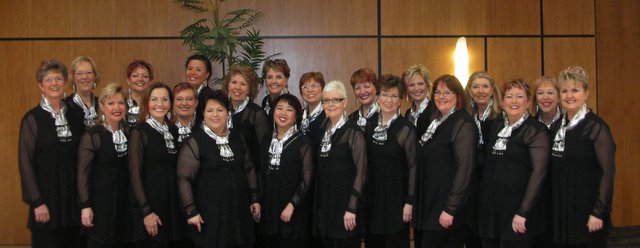 Members range in age from 20 to 75 and come from a wide range of occupational backgrounds. Membership includes women from all walks of life who come from Kamloops, Logan Lake and Merritt and the surrounding area of the interior of British Columbia.. The chorus provides a supportive environment for women who want to develop their musical skills. While some members sight read music, others learn by using recorded learning tracks. In our quest to improve, members participate in off site vocal workshops and educational weekend retreats to hone their performance skills.
Women who like to sing are invited to join Desert Sounds Harmony Chorus and share in the fun of singing and performing a variety of a cappella music in 4-part barbershop harmony. With a wide range of voice parts, women with high or low voices can find a part that is comfortable for them to sing. Voice parts include LEAD, TENOR, BARITONE & BASS. Come and experience the joy and fun of singing, friendship and good times at one of our Rehearsals! What is Barbershop Singing? Barbershop harmony is unaccompanied, four-part a cappella harmony. Although barbershop-style music is usually built on simple melodies and is relatively easy to sing, the a cappella style and the ear training necessary for independent part singing make it one of the most challenging and rewarding accomplishments of a vocal ensemble. When the music is sung accurately and with good breath support and vocal techniques, barbershop harmony produces overtone vibrations that create a resonant ring unique to this form of music. Ladies of all skill levels join us and their abilities are as varied as they are. It’s the coming together of these unique voices, talents and experiences that creates the space for an exciting ensemble. Here are the basics:
VOICE PARTS IN BARBERSHOP SINGING There are certain things you may want to know depending on the part you will be singing. Most of us are familiar with the SATB or SSAA choral music, where the melody is usually in the First Soprano line, above all others. The voice parts in barbershop harmony for women have different names and functions than they do in other SATB or SSAA vocal styles. The LEAD voice, generally sings the melody and is below the TENOR harmony; the TENOR part sings the highest note in the chord; the BARITONE part fills in the all-important missing note in a chord that may be above and below the melody; and the BASS part supplies the harmonic foundation (root or fifth) of the chord. Similar to choral music, minimal vibrato should be apparent in barbershop singing. Wide and obvious vibratos tend to hamper the “lock and ring” that we look for in our chords. TENOR is a harmony part sung consistently above the lead. The tenor should have a light, sweet, pure tone that will complement but not overpower or overshadow the lead voice. Light lyric sopranos generally make good tenors. The range for tenor is from G above middle C to high F on the top line of the clef. Occasionally you will have notes below the lead. When this happens, your tonal quality will need to change from being light and clear to being more full and round. Flexibility is the key and knowing when you need to change. LEAD is the melody and must be sung with BARITONE covers approximately the same range as lead. The voice part is similar to equivalent to Alto I except that baritone harmony notes cross the lead notes; primarily sung below the lead but sometimes sung above, depending on where the melody is situated. Baritones must constantly adjust their balance to accommodate their position in the chord. They must to have a good ear. BASS is the lowest note in the barbershop chord. Singers should have a rich, mellow voice and generally sing the root and fifth of each chord. The bass sings a relatively straight, well-produced tone with a minimum of vibrato. The range is comparable to that of a contralto or Alto II in traditional choral music. The range is from E-flat below middle C to G above middle C. Similar to the baritone, this part is written in the bass clef an octave lower than it is actually sung. A bass sings with a heavier tone quality than the others and generally with more volume, to fill out the “cone.” The bass part provides the foundation of each chord. THE BARBERSHOP CONE Barbershop harmonies have a different balance than the traditional cylindrical balance of SATB or SSAA ensemble music, in that our top voices sing with less weight and intensity than our lower voices. |
|
 authority, clarity, and consistent quality throughout her range. The lead sings with limited vibrato to add color and warmth to the sound. With too much use of vibrato the chord will not “lock” or “ring” or produce the unique full or “expanded” sound that is characteristic of barbershop harmony. The lead is responsible for conveying the interpretation, emotion, and inflections of the song. The range is equivalent to a Soprano II and is from A below middle C, and C above middle C. On the rarer occasions when the melody line is in another part, which may be only for a few notes, you will need to be aware to lighten your vocal quality to allow the melody to shine wherever it is being sung. If you are in a quartet, the others will follow your lead. In a chorus, we all follow the director.

|
